Financing for First-Time Flippers

Henry Tabeling
Founder & Lead Underwriter ·

Real estate rehabilitation projects demand both strategic physical planning and sophisticated capital structures. Selecting the appropriate source of financing can determine whether an investment yields a profit or results in a loss. For first-time flippers, navigating the mechanics of private asset-based funding is the critical first step to securing viable distressed properties.
Key Takeaways for First-Time Flippers
Essential financing guidelines for your first rehabilitation project:
- Experience Requirements: While experienced investors receive premium rates and higher financing ratios, beginners can readily secure financing by accepting conservative loan-to-value limits, typically ranging from seventy-five percent to eighty percent of the purchase price.
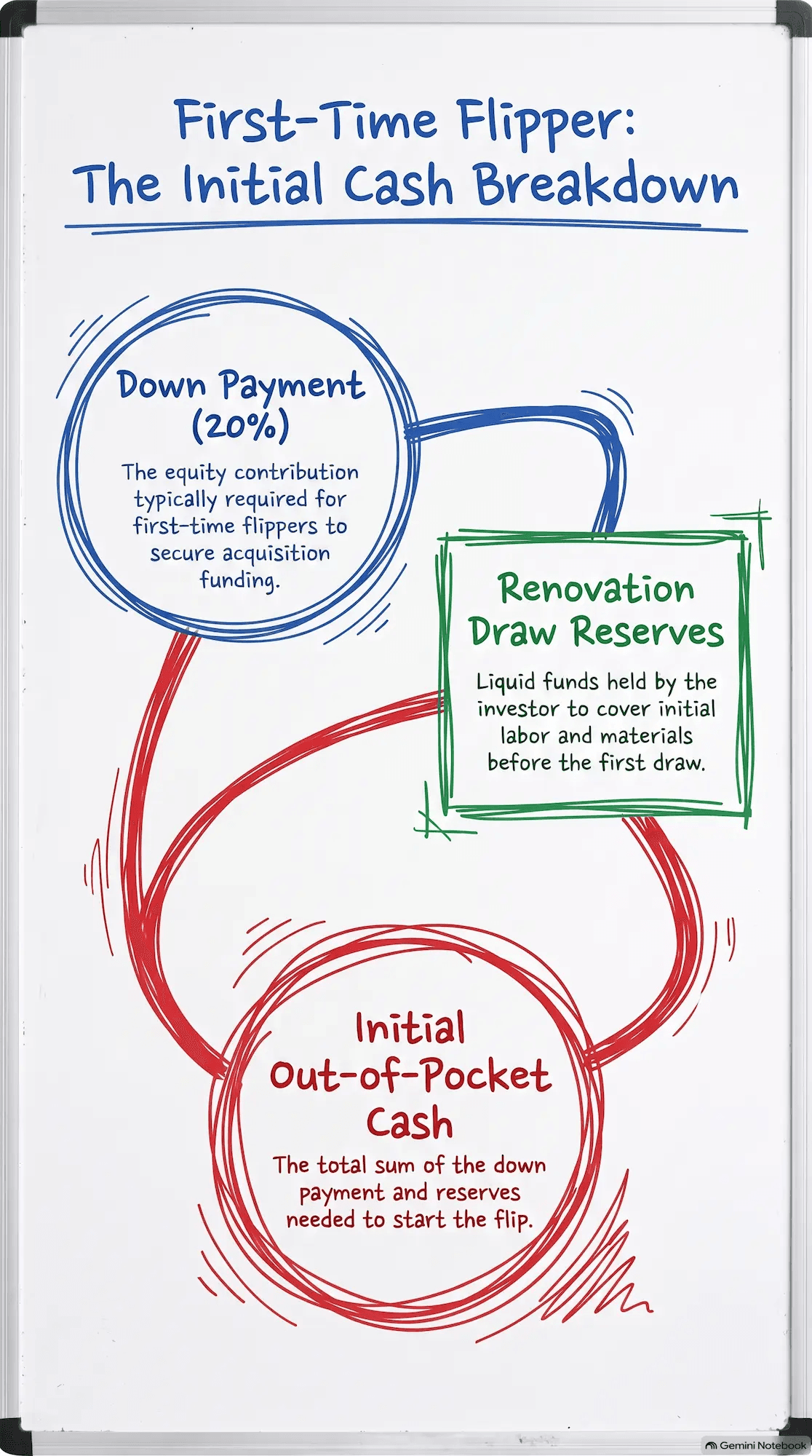
- Down Payment Capital: First-time flippers must expect to make a down payment of fifteen percent to twenty-five percent of the acquisition cost. Private financing is not 'zero money down' lending.
- The Rehab Draw Model: Renovation funds are distributed in arrears. Borrowers must possess sufficient liquid cash to fund the initial stage of construction before requesting a reimbursement draw.
- Closing Costs and Points: Upfront fees usually include two percent to four percent in origination points plus closing costs. These fees must be factored directly into the initial cash calculations.
- The Value of Your Team: Partnering with a licensed, experienced general contractor and a specialized real estate agent can mitigate a lack of personal experience during the underwriting review.
Understanding How Private Lenders Evaluate First-Time Flippers
Real estate rehabilitation offers significant wealth creation opportunities, but securing capital as a beginner requires a clear understanding of risk management. Traditional commercial banks require extensive historical records and personal income verification, which often disqualifies new investors. Direct private lenders, commonly referred to as hard money lenders, focus primarily on the value of the underlying real estate collateral. However, because a lack of experience increases project risk, these lenders adjust their terms to protect their capital.
Underwriters evaluate your real estate background to determine your loan terms. Experienced investors who have successfully completed multiple projects receive high financing limits and lower interest rates. As a first-time flipper, your lack of a track record means the lender will typically offer more conservative terms. For example, instead of financing ninety percent of the purchase price, a private lender may limit a beginner to seventy-five percent or eighty percent of the acquisition cost. This larger equity requirement reduces the risk of the transaction for the lending institution.
You can overcome a lack of personal experience by building a strong project team. Underwriters look favorably upon transactions where the borrower partners with experienced professionals. Hiring a licensed general contractor who has completed numerous local renovations provides the lender with confidence that the project will be finished on time and within budget. Additionally, working with a real estate agent who specializes in investment properties demonstrates that your resale projections are grounded in solid market data.
Capital Requirements: Calculating Your Out-of-Pocket Cash Needs
A common misconception in real estate investing is that hard money loans require no upfront capital. While private financing covers a significant portion of your acquisition and construction costs, you must still bring substantial liquid capital to the closing table. Understanding these out-of-pocket expenses is vital to prevent running out of money mid-project.
Your initial cash requirements consist of several distinct components. First, you must fund the required down payment, which typically ranges from fifteen percent to twenty-five percent of the purchase price. Second, you must cover the lender origination points, which are upfront fees ranging from two percent to five percent of the total loan amount. Third, you must pay standard closing costs, including title insurance, escrow fees, appraisal costs, and legal documentation fees.
Beyond the closing table, you must maintain sufficient cash reserves to carry the property. Hard money loans are structured as interest-only instruments with monthly payment obligations. You must hold three to six months of interest payments in reserve to ensure you do not default while renovations are underway. Furthermore, because renovation construction funds are released in stages, you must possess the cash necessary to pay your contractors for the initial phase of work.
Managing the Renovation Draw Process to Maintain Liquidity
The renovation draw process is a critical element of private real estate financing that beginners must master. When a private lender approves a construction budget, they do not hand over the entire renovation amount at closing. Instead, the rehabilitation funds are held in an escrow account and released in installments called draws.
The draw process operates on a reimbursement model. This means you must complete specific milestones of the renovation before the lender will release the matching funds. For example, you may need to complete the demolition, framing, and rough-in plumbing using your own cash or contractor credit. Once that phase is complete, you will request a draw. The lender will send an inspector to verify the work has been performed to professional standards. Upon a successful inspection, the lender will release the cash to reimburse you for that stage.
This structure requires careful cash flow management. If you fail to budget for the initial phase of construction, you will not have the capital to trigger the first draw, which can cause the project to stall. To avoid this bottleneck, you should negotiate a detailed draw schedule with your general contractor before starting work. Aligning your contractor payments with the milestones of the lender prevents cash flow mismatches and keeps the project moving forward smoothly.
Mitigating Project Risks: Crucial Steps for Beginner Success
Your first rehabilitation project is a learning experience where minimizing mistakes is more important than maximizing theoretical profits. Experienced flippers manage risk by focusing on conservative estimates rather than optimistic projections. Adhering to strict risk mitigation strategies will help protect your capital and ensure a successful exit.
The most critical step in risk mitigation is securing a comprehensive property inspection before closing. While hard money lenders perform valuations to protect their collateral, they do not conduct detailed physical inspections of major systems. You must hire an independent home inspector to evaluate the foundation, roof, plumbing, and electrical systems. Discovering structural defects after closing can instantly destroy your profit margin and exhaust your construction reserves.
Additionally, you must establish a contingency fund within your renovation budget. Unforeseen issues always arise during a rehabilitation project, especially in older properties. A healthy contingency reserve of ten percent to fifteen percent of the total construction budget ensures you can handle unexpected repairs without halting the renovation. This reserve protects your liquidity and ensures you can complete the project to secure your planned exit strategy.
Henry Tip: Partnering for Success
Do not let a lack of personal rehabilitation history discourage you. Partnering with a highly experienced licensed general contractor who handles the budget execution is the single most effective way to satisfy private underwriting requirements. Direct lenders value professional oversight and will often offer superior rates and terms when they know a verified professional is managing the physical renovation.
Comparing Project Budgets and Cash Requirements
To illustrate the physical cash impact of loan terms, let us examine a rehabilitation project with a purchase price of two hundred thousand dollars and a construction budget of fifty thousand dollars. The following matrix compares the cash requirements of a first-time flipper against an experienced investor.
| Financial Metric | First-Time Flipper | Experienced Investor |
|---|---|---|
| Purchase Price | $200,000 | $200,000 |
| Renovation Budget | $50,000 | $50,000 |
| LTV (Purchase) | 80.00% ($160,000) | 90.00% ($180,000) |
| LTC (Renovation) | 100.00% ($50,000) | 100.00% ($50,000) |
| Interest Rate | 11.50% (Interest-Only) | 9.50% (Interest-Only) |
| Origination Points | 3.00% ($6,300) | 2.00% ($4,600) |
| Required Down Payment | $40,000 (20%) | $20,000 (10%) |
| Upfront Closing Points | $6,300 | $4,600 |
| Initial Renovation Stage Cash | $15,000 | $15,000 |
| Interest Reserves (6 months) | $12,075 | $10,925 |
| Total Liquid Capital Required | $73,375 | $50,525 |
The cost comparison highlights the direct correlation between your financing ratio and your liquid capital requirements. In this scenario, the first-time flipper must bring sixty thousand dollars to the closing table, which represents a eighty percent loan-to-value ratio. Additionally, the investor must maintain twenty-five thousand dollars in liquid reserves to cover interest payments and the first construction milestone. This brings the total liquid capital requirement to eighty-five thousand dollars.
By contrast, an experienced investor with a proven track record would likely secure a ninety percent loan-to-value ratio. This increased funding limit reduces their required down payment and lowers their total out-of-pocket cash to forty-five thousand dollars. As a beginner, you must accept that your initial deals will require more personal capital. This structure protects the lender while you establish the experience required to qualify for higher funding limits on future transactions.
Five Strategic Steps to Secure Your First Private Loan Approval
- Verify Your Personal Credit and Liquidity: While private lenders focus on collateral, they still review your credit profile to ensure you do not have active bankruptcies or foreclosures. Gather your financial statements to demonstrate you possess the required cash reserves.
- Build Your Professional Local Team: Establish relationships with a licensed general contractor, a real estate agent specializing in investment properties, and an insurance broker. Presenting these partnerships to your lender shows you have the necessary support to execute the project.
- Analyze the Deal and Calculate the After Repair Value: Perform a thorough market analysis to determine the value of the property after all renovations are complete. Ensure your purchase price and construction budget align with local comparable sales.
- Prepare a Detailed Renovation Scope of Work: Write a line-by-line breakdown of every renovation task, including materials, labor, and timelines. A highly detailed scope of work proves to the lender that you understand the physical requirements of the project.
- Submit a Complete Application Package: Provide the lender with your property contract, contractor estimates, scope of work, proof of funds, and entity documentation. A complete, organized application package demonstrates professionalism and speeds up the underwriting process.
Selecting the Right Capital Partner for Your Investment
Securing the right financing is just as important as finding the right property. A reliable private lender is more than a source of debt; they are a key partner in your real estate business. When evaluating potential lenders, focus on transparency, speed, and their local market experience rather than just the lowest interest rate.
To begin your investment endeavors, seek out direct private lenders who specialize in residential rehabilitation. Discuss your project goals openly and work with them to structure a loan that protects your liquidity. By mastering the fundamentals of private underwriting, capital requirements, and draw schedules, you will position yourself to successfully execute your first transaction and build a profitable real estate portfolio.
Got A Deal That Needs Funding?
Send us the address and your numbers. Get terms same-day and close in as little as 24 hours.