One of the first questions investors ask is simple. What's the interest rate?
The honest answer is that there isn't one rate for every deal.
Hard money lenders price loans based on risk. Two investors buying similar properties can receive different terms because every deal is evaluated on its own merits. The purchase price, property condition, loan amount, equity, experience, exit strategy, and local market all influence pricing.
In 2026, most hard money loans fall within these general ranges:
| Loan Feature | Typical Range (2026) |
|---|
| Interest Rate | 8% to 15% |
| Origination Fee | 1 to 4 points |
| Loan Term | 6 to 24 months |
| Funding Time | Often 3 to 10 business days |
| Loan Structure | Frequently interest only |
These numbers represent the broader hard money market. Actual loan terms depend on the lender and the details of the transaction.
The biggest mistake investors make is comparing only the interest rate.
A lower rate doesn't automatically mean a better loan. One lender might advertise a lower rate while charging higher points, additional fees, or stricter extension terms. Another lender may charge a slightly higher rate but close faster, finance more of the project, or offer a smoother draw process.
Look at the total cost of borrowing, not just one number.
If paying a little more allows you to secure a property with strong profit potential, the math often works in your favor. If the deal only works because you're chasing the absolute lowest rate, you may want to look at the deal again before signing anything.
What Are Points?
Points are an origination fee charged by the lender at closing.
One point equals one percent of the loan amount.
For example, if you're borrowing $300,000 and the lender charges two points, you'll pay $6,000 in origination fees.
Points are common in hard money lending because these loans are short term. Instead of earning interest over 30 years like a bank, lenders recover part of their costs through origination fees.
Points shouldn't automatically scare you away.
Sometimes paying an extra point for a faster closing, higher leverage, or better loan structure makes more financial sense than choosing the cheapest quote available.
Every deal is different.
What Determines Your Interest Rate?
Investors often ask why someone else received a better rate.
The answer usually comes down to risk.
Lenders evaluate the entire transaction before pricing a loan.
Factors that commonly influence pricing include:
- Your experience with similar projects
- The amount of money you're investing in the deal
- The property's condition
- The loan amount
- Loan-to-Value (LTV)
- After Repair Value (ARV)
- Your exit strategy
- The local real estate market
- The property's location and resale potential
An experienced investor buying in a strong market with plenty of equity generally presents less risk than a first-time investor taking on a major renovation with very little cash invested.
That doesn't mean first-time investors can't qualify. It simply means lenders may look more closely at the overall project before making a decision.
Interest-Only Payments
Many hard money loans use interest-only monthly payments.
Instead of paying down the loan balance every month, you're only paying the interest while you own the property. The remaining balance is paid when you sell the property or refinance into long-term financing.
This structure keeps monthly payments lower during the project and helps preserve cash for renovations, carrying costs, and unexpected expenses.
Interest-only doesn't make the loan cheaper.
It simply changes when the principal is repaid.
Loan Terms
Hard money loans are designed to be temporary financing.
Most investors are not looking for a loan they'll keep for ten or twenty years. They're looking for financing that helps them complete a project and move on.
Most loan terms fall somewhere between six and twenty-four months.
The exact term depends on the project.
A cosmetic renovation may only require six months.
A major rehabilitation or new construction project may require considerably longer.
Before accepting any loan, make sure your timeline is realistic.
Construction delays, permit issues, contractor availability, and market conditions all affect how long a project takes to complete.
Funding Speed
Speed is one of the biggest reasons investors choose hard money.
Traditional mortgages often take thirty to forty-five days to close.
Hard money loans can often close much faster because underwriting focuses primarily on the property and the investment itself rather than weeks of income verification and bank documentation.
That doesn't mean every loan closes in just a few days.
Title work still needs to be completed.
Insurance must be in place.
Property valuations may still be required.
Borrowers also need to provide requested documentation promptly.
The smoother everyone works together, the faster the loan can close.
How Lenders Decide How Much to Lend
Every investor wants to know the same thing.
How much will the lender finance?
The answer usually comes down to three numbers.
- ARV.
- LTV.
- LTC.
Understanding these numbers before submitting a deal will save you time and help you evaluate properties more accurately.
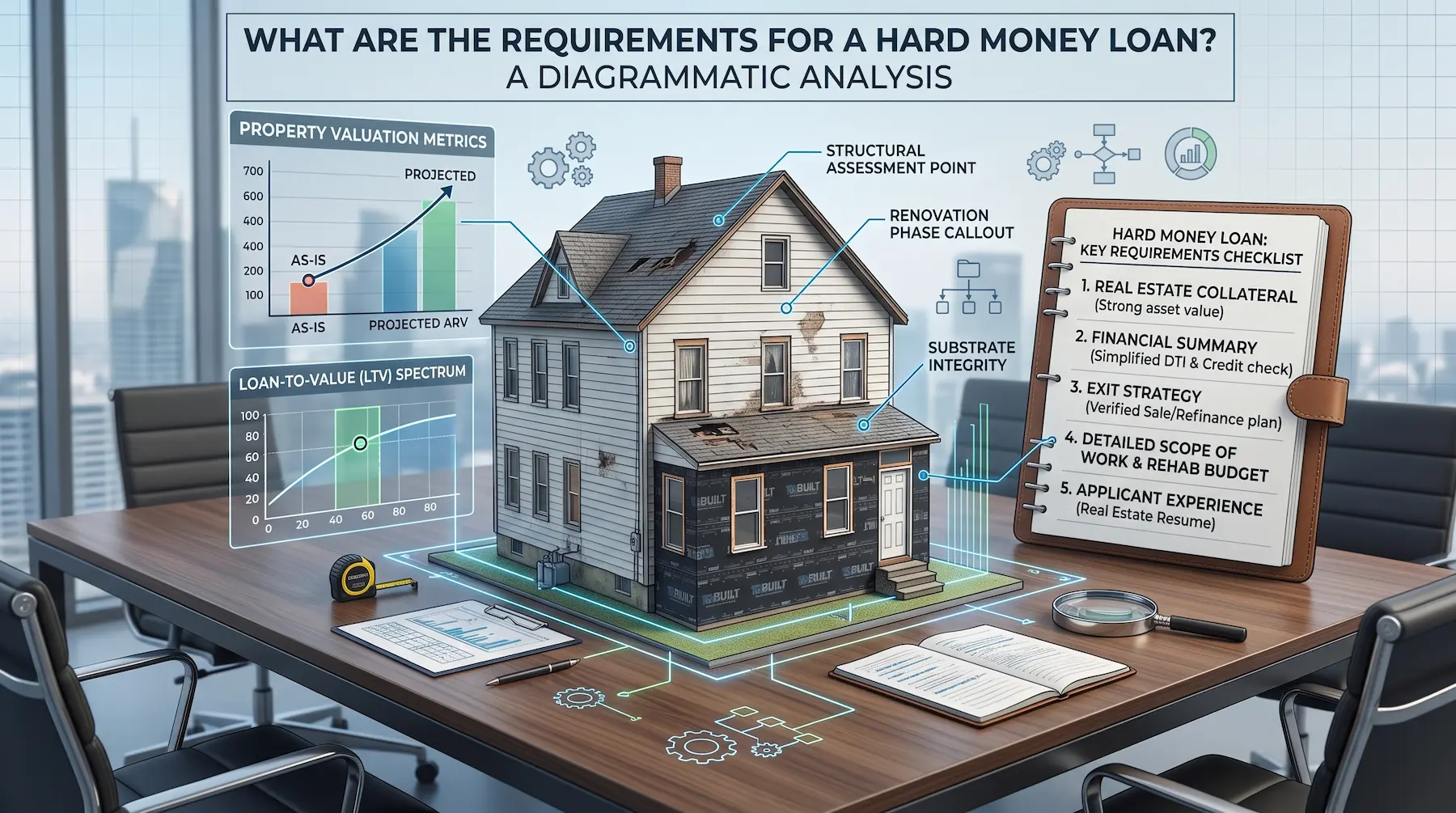
After Repair Value (ARV)
ARV stands for After Repair Value.
It's the estimated market value of the property after renovations have been completed.
Lenders use ARV to estimate the property's future value and determine how much they're willing to lend.
ARV isn't a guess.
It's based on comparable sales, market conditions, renovation plans, and the expected finished condition of the property.
If your ARV is unrealistic, the entire deal starts to fall apart.
Loan-to-Value (LTV)
Loan-to-Value measures the size of the loan compared to the property's value.
For example, if a lender approves a $210,000 loan on a property worth $300,000, the loan is at 70 percent LTV.
Lower LTV generally means less risk for the lender.
Higher LTV means the lender is financing a larger percentage of the property's value.
Loan-to-Cost (LTC)
Loan-to-Cost compares the loan amount to the total project cost.
Project cost includes the purchase price and planned renovations.
If the purchase price is $200,000 and renovations cost another $50,000, the total project cost is $250,000.
If the lender finances $225,000, the loan represents 90 percent of the total project cost.
LTC helps determine how much cash you'll need to bring to closing.
Example Deal
- Purchase price: $200,000
- Rehab budget: $50,000
- Total project cost: $250,000
- Estimated ARV: $325,000
Assume the lender is willing to finance 90 percent of the purchase price, 100 percent of the rehab budget, while limiting the loan to 70 percent of ARV.
Ninety percent of the purchase price equals $180,000.
Add the $50,000 rehab budget and the total loan reaches $230,000.
However, 70 percent of the $325,000 ARV equals $227,500.
Since the lender won't exceed the ARV limit, the final loan amount becomes $227,500.
That means you'll need to cover the remaining purchase funds, your loan fees, and closing costs.
Running these numbers before making an offer gives you a much clearer picture of how much cash you'll actually need to complete the project.

 Hard MoneyFeatured