What Are the Requirements for a Hard Money Loan?

Henry Tabeling
Founder & Lead Underwriter ·
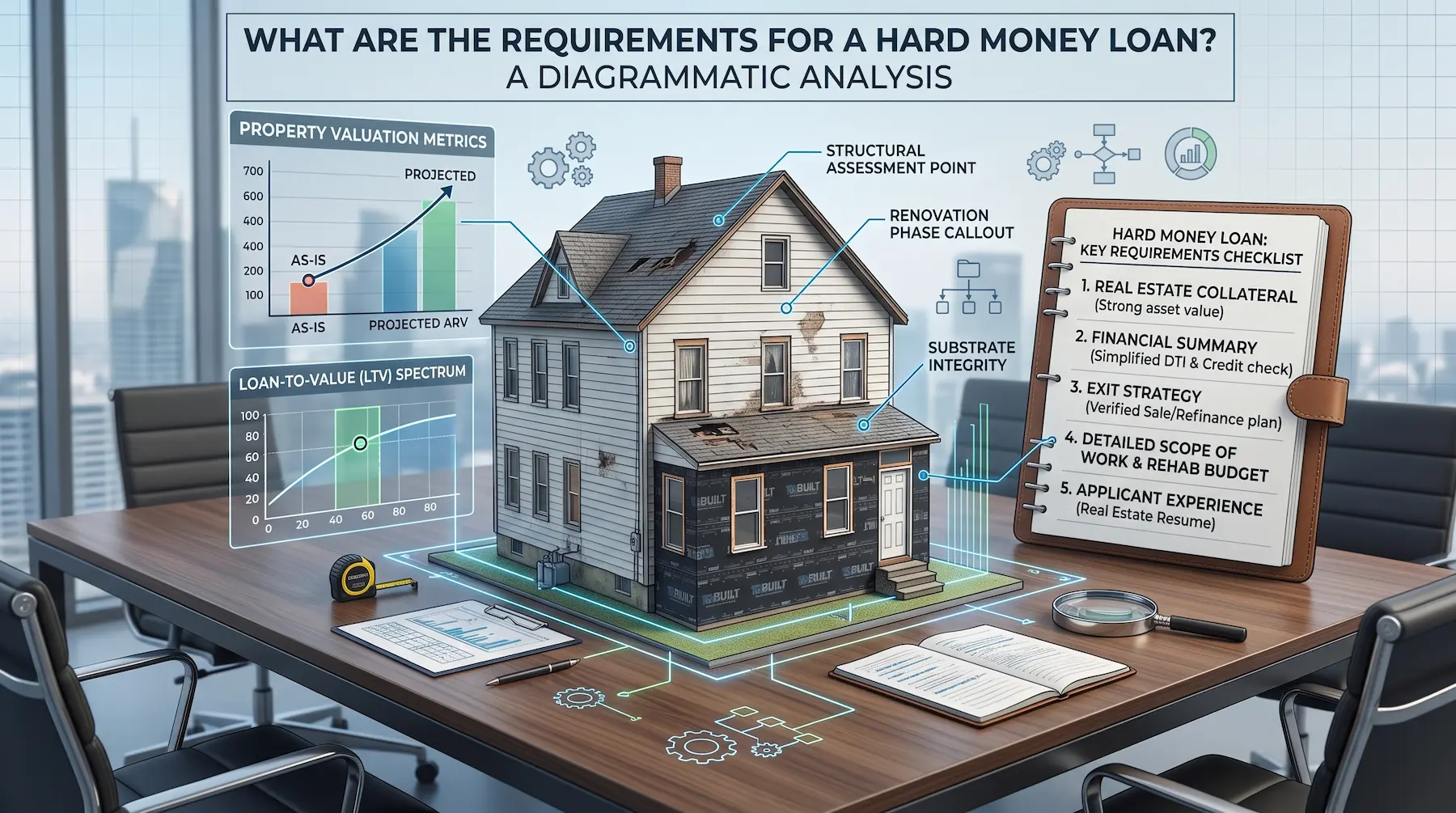
Real estate investors often utilize private financing to bypass the rigid, time-consuming requirements of conventional bank mortgages. Understanding hard money loan requirements is essential for securing fast, reliable capital for time-sensitive acquisitions. Private lenders evaluate transactions differently than traditional financial institutions, prioritizing collateral value over personal history.
This guide demystifies the underwriting requirements of private loans. It details the key benchmarks for credit scores, cash reserves, down payments, and corporate entity structures. By understanding these criteria, you can position your next investment project for rapid approval and funding.
KEY TAKEAWAYS
- Business Purpose Only: Hard money debt is strictly for investment and commercial properties; it cannot be utilized for owner-occupied primary residences.
- Credit Score Baseline: Private underwriters generally require a minimum credit score of 620 to ensure basic financial responsibility.
- LLC Entity Requirement: Loans must be closed under a registered business entity such as an LLC, protecting personal assets and clarifying commercial intent.
- No Tax Returns or DTI: Private lenders do not collect tax returns, verify personal paychecks, or calculate debt-to-income ratios.
- Cash Reserves and Equity: Borrowers must maintain sufficient cash reserves to cover down payments, origination fees, and initial holding costs.
Business-Only Capital: The Absolute Restriction on Owner-Occupancy
The first and most critical rule of hard money lending is the occupancy restriction. Direct private loans are designed strictly for business, commercial, and investment transactions. You cannot utilize a hard money loan to purchase, refinance, or renovate an owner-occupied primary residence or secondary home. Federal regulations protect consumer mortgages under different laws, making private business debt unsuitable and illegal for personal housing.
Private lenders require borrowers to sign business-purpose declarations at closing. These documents state under penalty of perjury that the capital will only be deployed for investment activity. If you intend to occupy the property even temporarily, you must secure a traditional bank mortgage or consumer loan. Recognizing this absolute boundary prevents compliance complications and ensures your transaction is structured appropriately.
Demystifying the Underwriting Box: Key Criteria
Although private lending is asset-based, direct lenders do not operate in a regulatory vacuum. To ensure successful loan execution and project completion, underwriters analyze specific personal and corporate factors. The primary underwriting criteria form a protective box that guarantees both borrower commitment and asset protection.
Minimum Credit Score of 620
Direct private lenders generally establish a credit score baseline of 620. While private underwriting does not require the immaculate credit history demanded by Fannie Mae, a 620 score represents basic financial stability. This score demonstrates that you manage existing obligations without active defaults, foreclosure history, or bankruptcy filings. Borrowers with credit scores below 620 can occasionally secure financing, but they may face higher interest rates or lower leverage limits.
The LLC or Corporate Entity Requirement
Private financing requires you to close the loan under a registered business entity. This is typically a Limited Liability Company (LLC), a C-Corporation, or an S-Corporation. Lending to an LLC reinforces the commercial nature of the transaction and helps shield personal assets. To satisfy this requirement, you must provide your direct lender with corporate articles of organization, an Employer Identification Number (EIN) from the IRS, and an operating agreement.
Down Payment and Liquid Cash Reserves
Hard money loans are rarely structured for one hundred percent financing of the acquisition price. A typical hard money down payment ranges from 10% to 25% of the purchase cost, depending on experience. In addition to the down payment, direct private lenders evaluate your liquid cash reserves. Underwriters look for liquid funds sufficient to cover closing points, upfront property insurance, and three to six months of interest holding payments.
Having these reserves prevents project failure. If your construction draw schedule operates on a reimbursement model, you must possess the cash to fund initial contractor work before requesting a draw. Lenders will verify these liquid assets by reviewing two consecutive months of corporate bank statements.
Henry Tip: Do not rely solely on your equity to pass underwriting. Private lenders require clear proof of cash liquidity. Always maintain a separate emergency reserve equal to fifteen percent of your estimated renovation budget to handle unexpected material delays or labor issues.
The Appraisal Exception: Bypassing the Traditional Bank Valuation
Traditional banking institutions require a formal third-party appraisal on every property before issuing a mortgage. These appraisals can take several weeks, and they often lead to deal delays or outright cancellations if the value does not meet strict guidelines. For real estate flippers and developers, waiting for a formal appraisal can mean losing a competitive transaction to a cash buyer.
Direct private lenders address this friction by offering appraisal-waived financing for qualified projects. Instead of mandating an expensive, slow third-party appraisal, we perform rapid internal valuations based on comparable local sales and the projected After Repair Value. This internal review allows us to issue commitment letters in twenty-four hours and close transactions in five to fifteen business days. There are select exceptions where a private lender may still require a third-party valuation (such as properties in rural areas with limited transaction history or highly unique commercial projects) but for standard residential investments, the traditional appraisal process is completely bypassed.
True "No Credit" Loans vs. Flexible Credit Underwriting
A common misconception in the real estate investing community is that private capital works on a strict "no credit check" model. While some high-cost lenders advertise no-credit structures, these loans often carry severe restrictions, such as requiring a massive down payment of thirty to forty percent of the purchase price and charging extremely high interest rates.
Rather than offering a blind no-credit program, direct private lenders utilize a flexible, common-sense underwriting framework. We pull and review your credit score to verify basic financial health and ensure you do not have active bankruptcies, recent foreclosure proceedings, or outstanding tax liens. However, unlike a conventional bank which will issue an automated rejection for scores below standard guidelines, we evaluate credit as just one part of your overall application. If you have a solid deal with strong equity protection and a clear exit strategy, we can structure the transaction even with a lower credit score, ensuring you secure the capital you need without traditional credit boundaries.
No Tax Returns or DTI: Why Private Financing Simplifies Underwriting
Conventional bank loans require exhaustive income verification. A typical commercial or residential bank program mandates two years of personal tax returns, two years of corporate returns, W-2 statements, and detailed profit-and-loss statements. Additionally, the bank will calculate your personal Debt-to-Income (DTI) ratio, which measures your recurring monthly liabilities against your gross income. This restrictive metric can instantly disqualify active real estate investors who leverage debt across multiple properties.
Direct private lenders operate under a common-sense, asset-based underwriting model. We do not collect personal tax returns, and we do not calculate your personal DTI ratio. Instead, the underwriting focus is oriented entirely toward the asset and the transition strategy. By ignoring complex consumer financial ratios, private financing allows self-employed real estate investors to secure terms based on the financial merit of their real estate holdings.
Does Experience Matter? Requirements for Beginners vs. Seasoned Flippers
Your track record as an investor significantly influences how private lenders structure your loan parameters. Direct private lenders support both beginners who have completed zero to one transaction and seasoned investors who have successfully executed three or more deals in the past twenty-four months. While both tiers can secure funding, the underwriting terms and leverage options vary based on historical performance.
Requirements for New-Timers (0 to 1 Closed Deal): Beginners are welcome, but represent higher risk due to a lack of construction management experience. Lenders typically require a larger down payment, often fifteen to twenty-five percent of the acquisition price. Underwriters also mandate higher liquid cash reserves to ensure the beginner can handle potential project delays without running out of cash.
Requirements for Seasoned Investors (3+ Closed Deals): Investors with a verified track record of three or more successful projects in the last twenty-four months receive premium terms. Down payments can drop as low as ten percent of the purchase price, and renovation financing can reach one hundred percent of costs. Lenders also provide faster processing, smaller reserve requirements, and more favorable interest rates.
Worked Example: Requirements for $250,000 vs. $500,000 Transactions
To visualize how these requirements scale with different project scopes, let us analyze two typical scenarios. Scenario A represents a moderate single-family renovation with a total budget of $250,000. Scenario B represents a larger luxury remodel or small multi-family transition with a total budget of $500,000.
As shown in the matrix below, while the basic requirements (such as the LLC entity and the omission of tax returns) remain constant, your financial obligations scale proportionally. A larger $500,000 transaction demands a more comprehensive reserve cushion of $45,000. This ensures you have enough capital to fund large-scale material purchases and handle interest carry over a longer development cycle.
| Loan Requirement Metric | Scenario A ($250,000) | Scenario B ($500,000) |
|---|---|---|
| Estimated Property Purchase | $180,000 | $380,000 |
| Rehabilitation Budget | $70,000 | $120,000 |
| Total Loan Amount | $215,000 (90% LTV) | $425,000 (85% LTV) |
| Minimum Credit Score | 620 | 620 (Preferred 650+) |
| Borrowing Entity | Required (LLC/Corp) | Required (LLC/Corp) |
| Tax Returns / DTI | Not Collected / No DTI | Not Collected / No DTI |
| Required Down Payment (15%) | $27,000 | $57,000 |
| Estimated Liquid Reserves | $20,000 (Carry + Points) | $45,000 (Carry + Points) |
| Personal Guarantee | Required (All Members) | Required (All Members) |
Step-by-Step Guide: How to Prepare Your Deal for Hard Money Underwriting
To expedite your funding timeline and secure a commitment letter in twenty-four hours, you must approach underwriting with a clean file. Follow these sequential steps to prepare your investment proposal:
1.Form Your LLC and Open a Business Bank Account: Ensure your corporate entity is fully registered with your state and possesses a valid EIN from the IRS. Create a dedicated business bank account where your liquid reserves will sit.
2.Obtain a Detailed Contractor Scope of Work (SOW): Underwriters require a line-by-line breakdown of all renovation costs, including labor and materials. A vague estimate will cause immediate underwriting delays.
3.Compile Your Liquid Asset Statements: Gather two consecutive months of corporate bank statements showing sufficient funds for the required down payment and interest carry reserves.
4.Verify Property Comparable Sales: Gather local comparable closed transactions within a half-mile radius that support your estimated After Repair Value (ARV). This reinforces the strength of your collateral.
5.Submit Your File to the Decision Maker: Submit the property address, purchase contract, scope of work, and corporate documents for a common-sense review.
Navigating the Underwriting Process Successfully
Hard money loan requirements are structured around the financial viability of your real estate deal. By focusing on collateral value, requiring corporate structures, and skipping traditional tax calculations, direct private lenders provide a flexible capital source for active investors. Ensuring you maintain a 620 credit score, establish an LLC, and possess solid cash reserves will allow you to close deals rapidly. If you have a profitable transaction and want to review your specific financing options, you can submit your deal parameters for a rapid asset-based evaluation.
Frequently Asked Questions
01. Can I qualify for a hard money loan if I have never completed a real estate transaction?
Yes, you can qualify as a first-time investor. While direct private lenders favor historical experience, beginners can easily secure financing by offering strong collateral, providing a comprehensive scope of work, and possessing slightly larger down payments and cash reserves to offset construction risks.
02. Why do direct private lenders require an LLC or corporate entity to close a loan?
Lenders mandate corporate entities to ensure the transaction remains strictly commercial and business-purpose. It also provides asset protection for the borrower and allows the transaction to bypass restrictive personal consumer credit laws that apply to traditional bank mortgages.
03. What is the absolute minimum credit score required to secure a private loan?
The standard baseline credit score is 620. Borrowers with lower scores can sometimes qualify if the property has a massive equity buffer or a low Loan-to-Value ratio, but they should expect higher interest rates or larger down payment requirements to mitigate the additional risk.
04. Do private lenders calculate debt-to-income (DTI) ratios during underwriting?
No, direct private lenders do not calculate personal debt-to-income ratios. Underwriters focus entirely on the property value, the estimated rehabilitation costs, and the viability of your exit plan rather than analyzing your recurring monthly personal bills against your paycheck.
05. Can I use a hard money loan to purchase a duplex if I intend to live in one of the units?
No, you cannot utilize a hard money loan for any owner-occupied property, including a multi-family building where you reside in one of the units. Private commercial capital is strictly restricted to business-purpose investments where no borrowing entity or personal guarantor occupies the real estate.
Got A Deal That Needs Funding?
Send us the address and your numbers. Get terms same-day and close in as little as 24 hours.