Pros and Cons of Hard Money Loans: An Honest Lender's Perspective

Henry tabeling
Founder & Lead Underwriter ·

Most comparisons of real estate financing strategies are written by marketing agencies or brokers who have never funded a single transaction with their own capital. At Hard Money Henry, we analyze these structures from the perspective of a direct private lender who manages risk and deploys capital daily. This guide delivers a transparent, unfiltered analysis of the real trade-offs and costs of private bridge debt, allowing you to make an informed decision for your next acquisition.
What Is a Hard Money Loan?
Most comparisons of real estate financing are written by marketing companies or brokers. At Hard Money Henry, we look at it from the lender's side. We put our own capital into these deals, so we understand the risks and the numbers behind them. This guide lays out the real pros and cons of hard money loans so you can decide if this type of financing makes sense for your next deal.
A hard money loan is a short-term loan secured by real estate. Unlike a conventional mortgage, the main focus is on the property and the deal rather than the borrower's income, tax returns, and financial history. These loans are generally funded by private lenders instead of traditional banks.
That's the main difference. A bank loan is built for long-term, lower-cost financing and usually comes with a long underwriting process. Hard money is meant to be temporary. You pay more for the money, but you get faster decisions, more flexible underwriting, and a loan that can be structured around the deal.
The Pros of Hard Money Loans
Faster Closing
When you're competing with cash buyers, speed matters. A conventional mortgage can take 30, 45, or even 60 days because the file has to go through multiple reviews and approval steps.
A direct private lender can move much faster. Since we manage our own capital, we can review the deal, issue a commitment, and fund it in as little as five to fifteen business days. In certain situations, such as a last-minute deal where another lender failed to close, a direct lender may be able to close within 48 hours.
No Traditional Appraisal Requirement
A traditional appraisal can hold up a deal for weeks. The appraiser has to inspect the property and find comparable sales that meet the lender's requirements. If the appraisal comes in low, the entire deal can fall apart.
For many standard projects, Hard Money Henry uses an internal valuation instead. We look at local comparable sales and the property's expected After Repair Value. This can cut out weeks of waiting for a formal third-party appraisal.
The Deal Matters, Not Just Your Credit
Banks put a lot of weight on your personal financial history. A high debt-to-income ratio or past credit problems can get a loan rejected even when the property itself is a good deal.
Private lenders take an asset-based approach. Credit is still reviewed, but the property and the amount of equity protecting the loan are much more important. If the deal has enough equity and a realistic exit strategy, it may still work. This can be especially useful for self-employed investors whose income looks different on paper because of business deductions.
Keep More of Your Cash Available
Buying an investment property with all cash can tie up a lot of your money in one deal. That leaves less cash available for another opportunity, unexpected expenses, materials, or contractor payments.
Private financing can help keep some of that cash available. A hard money loan may cover up to 90% of the purchase price and 100% of the renovation budget. That gives you more room to handle unexpected costs, take on another deal, or keep your operating reserves intact.
You Can Talk Directly to the Lender
With a traditional mortgage, your file may pass through brokers, processors, call centers, and loan committees. If something unusual comes up with the property, getting an answer from the person making the final decision can take time.
With a direct lender, you have a direct line to the people making the decision. If something needs to be explained or the loan structure needs to be adjusted, you can deal with it directly instead of waiting for another committee or department.

The Cons of Hard Money Loans
Higher Interest Rates
There's no getting around it: hard money costs more than a conventional bank loan. Rates typically range from 8% to 15%, depending on the property, renovation, deal risk, and your experience as an investor.
That higher rate is the trade-off for speed and flexibility. Private lenders take on more risk when they finance distressed properties and don't require the same level of income documentation as a bank. You need to include the interest expense in your project numbers from the start.
Shorter Loan Terms
A conventional mortgage can run for 15 to 30 years. Hard money is different. It is a short-term bridge loan, with typical terms of six to 24 months. Payments are usually interest-only, with the remaining principal due when the loan matures.
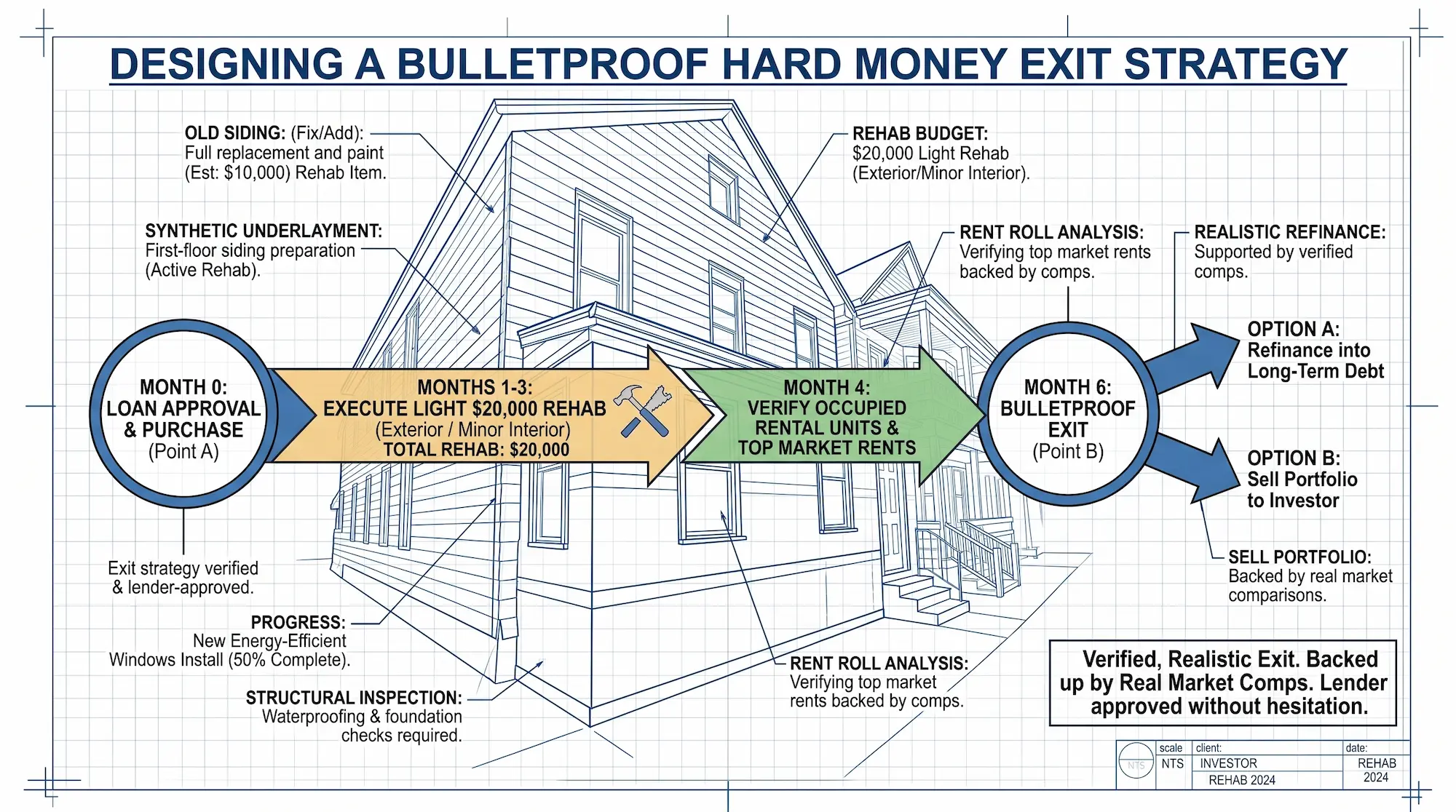
That means you need a real exit strategy. You either need to sell the property, refinance it, or otherwise pay off the loan before maturity. If the project runs long, you could end up paying extension fees or dealing with a default.
Bigger Down Payment and Upfront Points
Conventional loans can sometimes offer low down payments, especially through government-backed programs. Hard money lenders generally want the borrower to have some money in the deal.
You should generally expect a 10% to 25% down payment, along with origination points. These points are commonly 2% to 5% of the total loan amount and are paid at closing. Make sure you have enough cash to cover these costs without taking money away from the renovation budget.
Hard Money Is Not for Long-Term Holds
Hard money usually does not make sense if you plan to hold a property for many years. The higher interest rate and short loan term can eat into your rental cash flow and create refinancing problems.
Private debt is a temporary financing tool. It works well for buying a property, completing the renovations, and getting out of the loan. If you plan to keep the property, you should have a plan to refinance into a conventional mortgage or a Debt Service Coverage Ratio loan after the property is stabilized.
When Does Hard Money Make Sense?
Hard money is not the right financing for every real estate deal. It makes the most sense when speed, flexible underwriting, and access to capital are more important than getting the lowest possible interest rate.
It can be a good fit for house flippers buying distressed properties that banks will not finance. It can also work for landlords using a Buy, Rehab, Rent, Refinance, Repeat strategy. Investors who need to close in less than two weeks or are buying through non-traditional business entities may also use private financing when a bank would take too long.
The question is not simply whether the interest rate is higher. The question is whether the financing helps you make money on the deal.
Say you find a property well below market value, but the seller wants to close in 15 days. A conventional loan may not be fast enough. If paying more for private financing lets you close on a deal with strong profit potential, the higher financing cost may be worth it.
Run the numbers before you commit. Compare the total cost of the loan, including interest and points, against your expected profit. If you are spending $20,000 on private financing and expect to make $80,000 after renovations, the financing cost may make sense. If the interest and fees eat up most of your profit, the deal probably does not have enough margin.
Common Questions About Hard Money Loans
One concern new investors have is whether private lending is safe compared with a traditional mortgage. Private lending is a legitimate commercial form of financing. The bigger risk is usually the deal itself. If your renovation takes too long or your exit strategy does not work, the interest and holding costs can add up quickly. Work with a lender that gives you clear, written loan terms so you know exactly what you are getting into.
Another issue is what happens when a renovation runs behind schedule. Material shortages, contractor problems, and other delays can push a project past the loan maturity date. A lender does not generally want to foreclose on a property. If the project is moving forward and you communicate with the lender early, an extension may be possible. Depending on the situation, that could give you another three to six months to finish the work, find a tenant, or sell the property.
Henry Tip
Have your exit strategy figured out before you close the loan. If you plan to sell, make sure there is demand for the finished property in that market. If you plan to keep it, make sure your long-term Debt Service Coverage Ratio financing is lined up before the hard money loan comes due.
Hard money has a higher cost and a shorter timeline than a conventional mortgage. In the right deal, though, the speed and flexibility can be worth it. If you have a property in mind, send Hard Money Henry the deal details and we can give you a direct loan quote without the sales pitch.
Got A Deal That Needs Funding?
Send us the address and your numbers. Get terms same-day and close in as little as 24 hours.