Hard Money Glossary of Terms: An Investor Guide to Private Debt Vocabulary

Henry Tabeling
Founder & Lead Underwriter ·
Real estate investment moves at the speed of private capital. When competing against all-cash buyers for distressed properties in high-demand markets across North Carolina and Virginia, speed of execution is your primary competitive advantage. Navigating private financing, however, requires a complete mastery of the specific legal, financial, and underwriting terminology used by direct private lenders.
Misinterpreting a single underwriting metric or contract clause can severely compress your profit margins or delay your construction loan closing. This comprehensive glossary breaks down essential private debt terminology into plain, transparent language, giving active real estate investors the exact framework needed to evaluate loan commitments and execute profitable transactions.
Core Financial Metrics: ARV, As-Is Value, LTV, and LTC
Understanding how direct lenders calculate risk and leverage is essential before submitting your loan application. Unlike traditional banking institutions that underwrite transactions based on personal income tax returns, private lenders evaluate property equity and projected after-repair metrics.
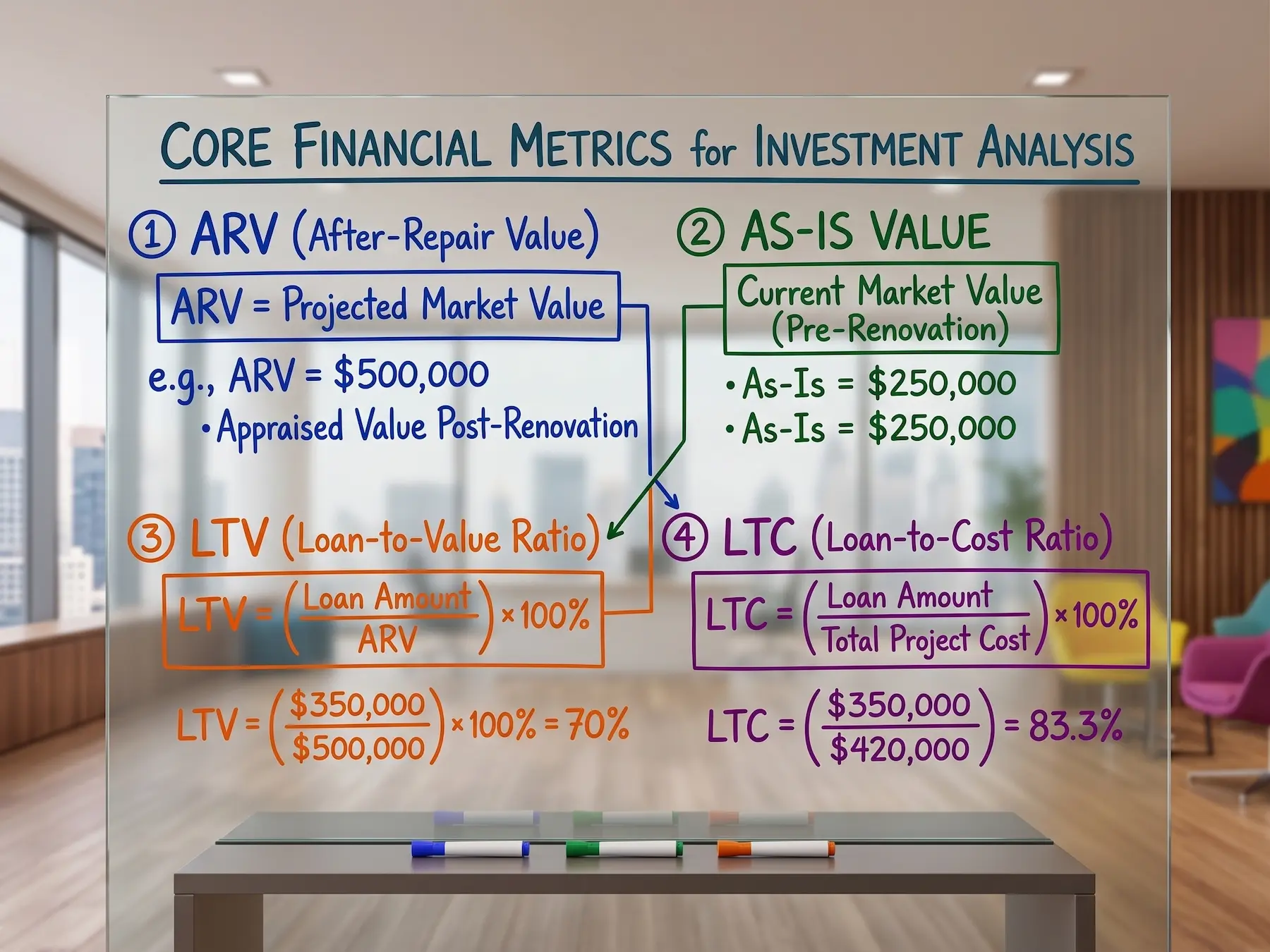
After-Repair Value (ARV)
The After-Repair Value represents the estimated fair market value of a property after all planned renovations, repairs, and capital improvements are fully completed. Direct private lenders establish the After-Repair Value using localized comparable sales that have closed within the past six months. Most private lending programs cap total loan leverage at sixty-five percent to seventy-five percent of the projected After-Repair Value.
As-Is Appraised Value
The As-Is Appraised Value represents the fair market value of the property in its current physical state prior to any demolition, remediation, or construction work. Lenders utilize this baseline to determine initial acquisition leverage before allocating construction draw funds.
Loan-to-Value (LTV)
Loan-to-Value expresses the ratio of the loan amount relative to the appraised value of the property. In hard money lending, Loan-to-Value can refer to either the As-Is Loan-to-Value (typically capped at seventy percent to eighty percent) or the After-Repair Value Loan-to-Value. Calculating Loan-to-Value ensures that sufficient equity remains in the asset to protect both the borrower and the lender.
Loan-to-Cost (LTC)
Loan-to-Cost represents the percentage of total project costs that the private lender is willing to finance. Total project costs include the purchase price plus the approved rehabilitation budget. Direct private lenders frequently finance up to ninety percent of total project costs, requiring the investor to provide the remaining ten percent as down payment equity.
Debt-to-Income (DTI) Exemption
Debt-to-Income measures personal monthly debt obligations against gross monthly income. Because direct private lenders evaluate business-purpose loans based on real estate collateral rather than consumer income, private debt underwriting completely waives traditional Debt-to-Income requirements.
HENRY TIP: Always verify whether a lender bases their maximum loan threshold on Loan-to-Cost or After-Repair Value. A lender offering ninety percent Loan-to-Cost capped at seventy-five percent After-Repair Value provides significantly higher capital leverage than a lender capping total exposure strictly at seventy percent of the acquisition price.
Primary Financial Metrics and Benchmark Table
The following reference table outlines the standard baseline benchmarks utilized by direct private lenders when evaluating fix-and-flip transactions:
| Metric Name | Formula and Definition | Standard Hard Money Benchmark |
|---|---|---|
| After-Repair Value (ARV) | Projected market value after complete renovation | 65% to 75% max ARV exposure |
| As-Is Value | Current property value before construction starts | 70% to 80% max As-Is LTV |
| Loan-to-Cost (LTC) | Loan Amount divided by Total (Purchase + Rehab) | Up to 90% of total project cost |
| Origination Points | Upfront lender fee paid at closing (1 point = 1%) | 1.0 to 3.0 points |
| Construction Holdback | Rehab funds held in escrow for milestone draws | 100% of approved rehab budget |
North Carolina Legal & Closing Terms
Real estate transactions in North Carolina operate under specific state statutes governing commercial lending, title settlement, and foreclosure procedures.
Essential Valuation Metrics: ARV, LTV, LTC, and DTI Exemptions in NC
In North Carolina real estate markets such as Charlotte, Raleigh, and Greensboro, direct lenders underwrite transactions using strict After-Repair Value metrics. Because North Carolina General Statutes Chapter 24 exempts commercial business-purpose loans exceeding twenty-five thousand dollars from state usury limits, lenders focus heavily on property valuation accuracy and construction budget feasibility rather than personal Debt-to-Income metrics.
NC Legal & Closing Terms: Deed of Trust, Power of Sale, Upset Bids & Escrow Draws
Every hard money loan in North Carolina is legally secured through a Deed of Trust recorded in the county registry where the property resides. North Carolina utilizes a non-judicial Power of Sale foreclosure structure. A critical legal component unique to North Carolina is the statutory ten-day Upset Bid Period mandated under North Carolina General Statutes Section 45-21.27. During a foreclosure sale, any party can submit an upset bid within ten days by depositing a five percent guarantee with the clerk of court, extending the bidding process in ten-day cycles.
Transactional Terminology: Points, Extension Terms, and Prepayment Penalties
Origination points represent upfront administrative fees paid at closing, where one point equals one percent of the total loan commitment. Extension terms provide structured thirty-day or sixty-day loan renewals if supply chain delays push project completion beyond the initial maturity date. Reputable direct lenders offering short-term bridge debt do not charge prepayment penalties, allowing investors to sell or refinance as soon as construction finishes.
HENRY TIP: When purchasing distressed properties in North Carolina, ensure that your contractor draw schedule aligns with local inspection workflows. Having construction funds released promptly upon site inspection prevents project delays and reduces holding costs.
Virginia Settlement & Legal Terms
Investing in Virginia real estate requires familiarity with Commonwealth commercial loan exemptions, title requirements, and settlement practices.
Fix-and-Flip Financial Metrics: ARV, As-Is Value, LTV & Construction Holdbacks in VA
In active Virginia markets like Northern Virginia, Richmond, and Hampton Roads, lenders evaluate current As-Is property appraisals against projected After-Repair Values. Approved construction funds are placed into an Escrow Construction Holdback account and released in reimbursement draws as renovation milestones are inspected and verified.
Virginia Settlement & Legal Terms: Deed of Trust, Commercial Exemption & Title Guarantees
Private capital transactions in Virginia are governed by Virginia Code Section 6.2-317, which exempts business-entity loans from consumer usury rate caps. Properties are secured via a Deed of Trust filed at the local circuit court. Virginia closing protocols require comprehensive lender title insurance and mechanic's lien coverage to protect against unrecorded contractor claims.
Borrower Qualification Terms: LLC Entity, Personal Guarantees & Proof of Funds
Direct lenders in Virginia require borrowers to hold title through an active business entity such as a Limited Liability Company or S-Corporation. Principal owners must execute a Personal Guarantee containing bad-boy carve-out provisions to ensure compliance with loan terms. Additionally, borrowers must submit a verified Proof of Funds letter demonstrating sufficient liquid capital to cover down payments and initial construction draws.
HENRY TIP: Establishing a dedicated Limited Liability Company for your Virginia real estate business accelerates closing timelines and provides essential liability separation between your personal assets and investment properties.
Contract Mechanics and Fee Structure Terminology
Understanding contract terminology prevents unexpected costs at the closing table. Below are key terms regarding loan fees and repayment structures:
Interest-Only Payments
During the loan term, monthly debt service payments consist strictly of interest charges calculated on the outstanding principal balance. No principal reduction occurs until the loan reaches maturity or is paid off.
Balloon Payment
A single lump-sum payment due at loan maturity that satisfies the full principal balance. For fix-and-flip investors, the balloon payment is paid off using proceeds from the property sale or a long-term DSCR refinance.
Draw Inspection Fee
A nominal administrative fee (typically one hundred fifty dollars to three hundred dollars) charged to cover third-party inspector visits when verifying completed construction work before releasing escrow draw funds.
Draw Escrow Account
A designated, non-interest-bearing escrow account managed by the lender that holds one hundred percent of approved construction funds until physical work is completed and inspected.
Actionable Due Diligence Checklist for Borrowers
Before signing a binding loan commitment, review your paperwork using this strategic checklist:
- Verify that loan leverage is explicitly stated as Loan-to-Cost and After-Repair Value percentages.
- Confirm that your loan paperwork contains zero prepayment penalties for early payoff.
- Ensure that your borrowing entity (LLC) is registered and active in the state where the property is located.
- Review the draw schedule to confirm turnaround times for rehab fund disbursements.
- Audit the settlement statement forty-eight hours before closing to verify all origination points and administrative fees.
Mastering private debt terminology empowers you to make informed decisions, negotiate favorable capital structures, and execute real estate transactions with complete confidence.
Got A Deal That Needs Funding?
Send us the address and your numbers. Get terms same-day and close in as little as 24 hours.