What Is a Hard Money Loan and How Does It Work?

Henry Tabeling
Founder & Lead Underwriter ·

Key Takeaways
- A hard money loan is a short term, non-conforming loan issued by private investors or companies rather than traditional financial institutions.
- Borrowers use real estate property as collateral to secure funding instead of relying primarily on personal creditworthiness.
- Approval times are fast, but hard money loans carry higher interest rates and shorter repayment periods, typically ranging from 6 to 36 months.
Hard money loans offer short term capital secured by real property. Real estate investors often rely on these loans when purchasing distressed properties or funding rapid property renovations.
Traditional mortgages require weeks or months to process because banks perform extensive credit checks and debt-to-income (DTI) ratio analysis. In contrast, hard money lenders prioritize the underlying asset's market value, allowing borrowers to access funds rapidly.
What Is a Hard Money Loan?
A hard money loan is an asset-based financing structure where a borrower secures capital using real estate. Private investors, real estate funds, or specialized private lending companies issue these loans instead of commercial banks or credit unions.
The term "hard" refers to the physical asset securing the debt. If a borrower defaults on their payments, the lender seizes the property through foreclosure to recover the principal balance.
How Does a Hard Money Loan Work?
Hard money lenders evaluate loans based on the property's potential market value rather than the borrower's personal balance sheet.
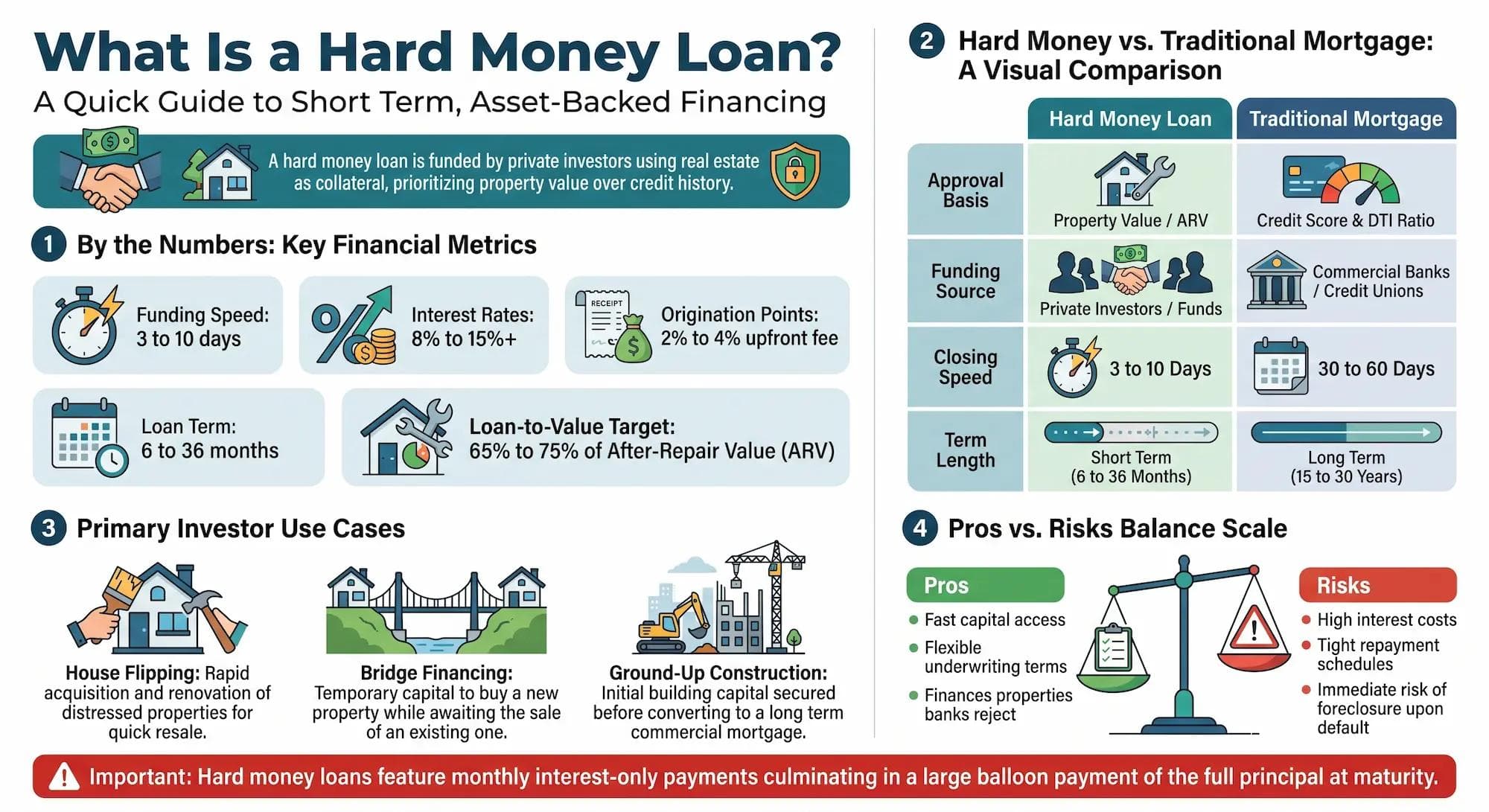
- Collateral and After-Repair Value (ARV): Lenders determine maximum loan amounts by calculating the After-Repair Value (ARV), which estimates the property's worth after planned renovations. Lenders typically fund between 65% and 75% of the ARV to limit risk in case of real estate market declines or project delays.
- Interest Rates and Fees: Higher default risk for private lenders results in elevated borrowing costs. Interest rates generally range between 8% and 15%, and lenders frequently charge upfront origination fees, known as points, equal to 2% to 4% of the total loan amount.
- Short Term Schedules: These loans act as short term bridge financing with maturities ranging from 6 months to 3 years. Borrowers typically pay monthly interest-only payments, concluding with a single balloon payment covering the full principal amount at the end of the term.
- Processing Speed: The simplified underwriting process enables funding within days rather than weeks, allowing real estate investors to close quickly on competitive properties.
Pros and Cons of Hard Money Loans
Pros
- Fast Funding: Transactions can close in 3 to 10 days.
- Flexible Approval Criteria: Approval relies on asset equity rather than credit score thresholds or strict debt-to-income limits.
- Financing for Distressed Properties: Private lenders fund homes requiring significant repairs that traditional banks refuse to finance.
Cons
- High Capital Costs: Double-digit interest rates and upfront origination points lower overall profit margins.
- Short Repayment Terms: Tight schedules leave little room for construction delays or market downturns before the final principal payment comes due.
- Foreclosure Exposure: Inability to execute renovations or secure long term refinancing risks immediate loss of the property.
IMPORTANT Defaulting on a hard money loan carries severe consequences. Because the property itself serves as direct collateral, private lenders can move quickly toward foreclosure to repossess the real estate and satisfy the debt.
Common Uses for Hard Money Loans
Real estate investors utilize hard money loans for specific transactional strategies:
- Property Flipping: Acquiring distressed residential real estate, renovating it quickly, and reselling it within 12 months.
- Bridge Financing: Securing temporary capital to purchase new real estate while awaiting the sale of an existing asset.
- Construction Capital: Funding initial ground-up development before converting to a traditional long term commercial mortgage once the structure is completed and fully leased.
Hard Money Loans vs. Traditional Mortgages
- Primary Approval Factor: Hard money loans evaluate property value and After-Repair Value (ARV). Traditional mortgages rely on borrower credit scores and debt-to-income (DTI) ratios.
- Funding Source: Hard money originates from private lenders or real estate investment funds. Traditional mortgages originate from banks or credit unions.
- Funding Timeframe: Hard money takes 3 to 10 days. Traditional mortgages require 30 to 60 days.
- Interest Rates: Hard money carries higher rates (8% to 15%+). Traditional mortgages offer lower, market-standard rates.
- Term Length: Hard money terms last 6 months to 3 years. Traditional mortgages span 15 to 30 years.
The Bottom Line
Hard money loans provide real estate investors with immediate capital when traditional financing is too slow or unavailable. While fast funding and property-focused approval criteria offer distinct operational advantages, high interest rates and short term repayment structures require precise project execution to avoid financial loss or foreclosure.
Got A Deal That Needs Funding?
Send us the address and your numbers. Get terms same-day and close in as little as 24 hours.